Showing posts with label Indian Crafts. Show all posts

Tuesday, December 18, 2018

A Soul Clenched

Initially I had titled my research paper as: Challenges and learning opportunities for Himroo of Aurangabad. As I was refining the paper further, the title felt more like an essay and less like a title. So I changed it to Himroo: A Soul Clenched
Why such a title? It is inspired from one of Pablo Neruda’s poem called Clenched Soul. Because I believe when circumstances give you a clenched feeling, or when you clench your teeth, it is time to fight back for yourself and make a significant change against the unpleasant circumstances you have been facing. Currently this is what Himroo of Aurangabad is facing – some unpleasant circumstances.

Himroo became a part of my life since 2007 when I was studying post graduate program in NID. For past 11 years it was an on and off relationship with Himroo which began as a craft documentation project, then a photo shoot project, a craft publication project and so on. In November 2018, with a clenched soul I decided to end this relationship by presenting a design research paper at INSIGHT 2018 – A Design Research Symposium at NID, Ahmedabad.
Indeed a clenched soul of Himroo and a clenched soul of myself form two different metaphors here. But life is that way – sometimes quite hopeful and not always determined. I go with what Rumi says, “Be like a tree and let the dead leaves drop.”

The research paper will be part of a publication by NID soon.
Sharing few images and slides of my presentation here.
I began and concluded the presentation with images of women Himroo weavers as they are the only hope for the craft to survive and sustain further. 

Thursday, June 29, 2017

Dhamadka - a "work from home" place

2008 was when I first visited Dhamadka and I seldom knew that over the years it would become such a special place for me, like a second home – the one after my mother’s.  
Traditional home to the ajrakh prints of Kutch, Dhamadka has been a place of work for natural dyes and hand block prints for me. Ajrakh to me is much beyond its process, it is more about the people who make it and how they use and cherish it in their daily lives. 
Along with work, living at Jabbar bhai’s place with his family, getting served with fresh gujju delicacies day in – day out, evenings with mehendi sessions and nights under the starry sky is what makes it a home away from home. Working in Dhamadka is like working from home and I make sure I do it at least once (3 to 4 days) every year!

Here is a small photo essay on Dhamadka... 
Indigo dyed fabrics drying under the sky
Wooden blocks / Ajrakh printed fabrics
Fabrics dyed in red kept for drying / Tools for clamp dyeing. 
Flowers / Floor at home / Indigo ground
Washed fabrics / Young dyers Ujeer and Mohammad / Detail of Ajrakh printed fabric
Fabric being washed / Jabbar bhai / Booklet for process of Ajrakh

Friday, October 7, 2016

CRAFT DESIGN, Lecture at NIFT, Navi Mumbai

I think of my teachers more when I am teaching. I consider myself a tad too lucky to have studied under the guidance of design thinkers like MP Ranjan and Aditi Ranjan at NID, particularly when it comes to crafts.

Craft being my favourite area of work, this was my first lecture on CRAFT DESIGN at NIFT, Navi Mumbai. (16th September 2016)

The aim of arranging expert lectures in design institutes is to give students a point of view of how things actually work on field. To show how design as a tool is applied to bring out necessary results, to show a larger picture of how design can create change and sustainability. The process of working with constraints, connecting several dots and extending your own boundaries with every project you work on.

A live design intervention project was given to students as part of their curriculum. The aim was to design commercially viable and market oriented products for crafts namely – Banjara Embroidery of Latur and Wall hangings of Solapur.

Designing for crafts, in my opinion is more about understanding and appreciating what exists. It is easy to pick faults but appreciating the existing is what it takes to keep things together. It is about being profound in one’s approach.  

I supported my lecture with two of my current craft projects.
One – Product design and development for the screwpine mat making craft of Kerala
Two – Embroidery designs for an NGO based in Madhya Pradesh

37 slides to present, 60 students with questions and 180 minutes to discuss – a small step to sensitize students towards designing for crafts.   

Sharing few of the slides from the presentation here…
I like to keep my presentation crisp with keywords, and lot of visuals (not shown here)


Books referred and recommended:
1. Viswakarma's Children by Jaya Jaitley
2. Thinking Design by S. Balaram

-

For design students and for students of life, here is an intriguing excerpt from one of Kabir’s poems -

Student, do the simple purification.

You know that the seed is inside the horse-chestnut tree;
and inside the seed there are the blossoms of the tree,
and the chestnuts and the shade.

So inside the human body there is the seed, and
inside the seed there is the human body again.

Fire, air, earth, water and space – if you don’t want the secret one,
you can’t have these either.

Friday, August 7, 2015

Know your Paithani, Dear Maushi

Dear Maushi,

This letter has long been pending and I thought today being the first National Handloom Day is an appropriate day to write. Thank you to GOI for marking such a day!

Firstly, I must tell you that you really boast my ego when you send pictures of your recently developed art and craft products or newly bought saree for my review! I feel that my little enthusiasm for textiles has seeped into the family as well. It is a nice feeling!

About a month back you shared some images of a Paithani saree you were gifted. Thank God it was a gift and you did not spend your earnings into that fake Paithani! But I feel depressed about the whole scenario that the person who bought it had no knowledge that she is buying a fake one and moreover the person who sold it is also unknown or has misguided purposely.  I know it is very difficult for a lay man to know the difference between the authentic and fake especially in the market today where there is a duplicate of almost everything. Polyester is sold as silk, print is sold as ikat and a jacquard is sold as paithani!

This is not Paithani!
Photographs sent on whats app by Mihir. 

I remember ajji’s paithani that you have. What a beauty she is! The fine interlacing of silk and pure gold… indeed a rate treasure!

As you know the most promising part in a paithani is its pallu decorated with motifs of peacocks, parrots, lotus’ amongst others and peacock being the most favourite. It will also be nice to know and acknowledge the tedious labour involved in the making of it, the skilled craftsmanship and the tradition which has seen centuries turn by.

Here are some pictures of making of the paithani, though these make no justice until the process is described in detail. But I do not intend to convert this letter into a thesis on Paithani!


 Photographs by Haris Pathirikodan at Aurangabad, Maharashtra

Unlike the rosogulla that is going through a debate on whether the GI rights are to be claimed by West Bengal or Orissa, the Maharashtrian Paithani has received its GI rights long back in 2010. These rights not only confirm the geographical area but also the historical origin, appropriate process of making and uniqueness of the craft.

The weaving of a paithani is such that it can be woven only on a handloom and not on a power loom.  It is difficult to give a brief explanation. So here are some basic specifics by which you can identify an authentic paithani:

1.     The motifs on the pallu have same color on the front and back side
2.     The pallu is a flat and even surface. No variation in thickness.
3.     No threads at the back side of the pallu are cut.

Traditionally, a paithani sari has motifs woven on the border and pallu both.  Keeping in mind affordability, revisions have been made where the motifs appear only on the pallu.

When you buy a traditional handloom saree, you not just buy a piece of cloth; you invest in the age old heritage of India and you sustain the second largest employment sector of our country. Isn’t that a wonderful feeling already?

Hope this letter inspires you enough to share the idea of identifying, buying  and using authentic traditional handwoven textiles.

Ending this letter with a poem by the weaver-poet Kabir

Weaving Your Name

I weave your name on the loom of my mind,
To make my garment when you come to me.
My loom has ten thousand threads
To make my garment when you come to me.
The sun and moon watch while I weave your name;
The sun and moon hear while I count your name.
These are the wages I get by day and night
To deposit in the lotus bank of my heart.

I weave your name on the loom of my mind
To clean and soften ten thousand threads
And to comb the twists and knots of my thoughts.
No more shall I weave a garment of pain.
For you have come to me, drawn by my weaving,
Ceaselessly weaving your name on the loom of my mind.

Love,
Aarti

Wednesday, October 2, 2013

Sunday, May 26, 2013

Terry Trailor

My first exploration of terry with some indigo and madder!
Yeh toh sirf trailor hai! Picture abhi baki hai..mere dost!


Saturday, October 6, 2012

{Happy Weekend}

These are the beautiful Ajrakh fabrics under process of coloring. This photograph was taken a few weekends back at Kutch, a place I love!
Have a great weekend everyone! :)

Sunday, October 2, 2011

The Khadi Stamp

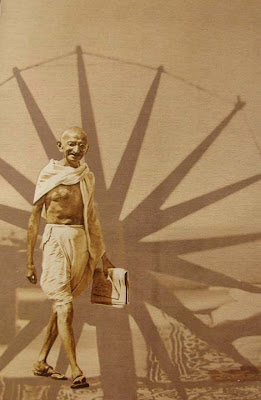
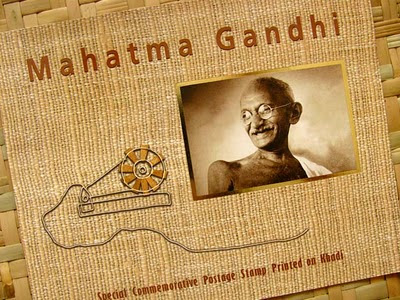
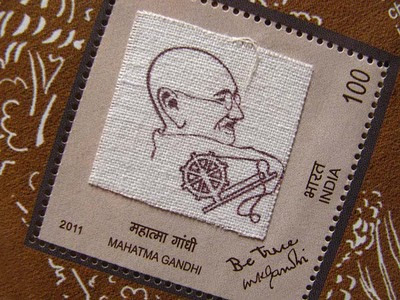
Im not a stamp collector who keeps track of the new and upcoming stamps in the philatelic bureau, but my friend DJ is one! Few months back she told me about the Mahatma Gandhi stamp which is printed on Khadi, and the very presence of textile in it interested me to posses one! Khadi is a new material for the philatelics and is indeed a wonderful one! This stamp was released in Feb 2011 in Delhi and with kind efforts we bought it from the philatelic bureau in Mumbai in June 2011. Dj has written a post about it here. 

Today, on the occasion of Gandhi Jayanti, I thought of sharing this proud possession on my blog!
All images are from the miniature sheet of the stamp. Several details of the stamp can be google-d!        
 
"The 'Khadi spirit' means fellow-feeling with every human being on earth. It means a complete renuncia of everything that is likely to harm our fellow creatures, and if we but cultivate that spirit amongst the millions of our countrymen, what a land this India of ours would be!" 
- MahatmaGandhi
Young India, 22-9-1927
This and many more rich thoughts of Gandhi on Khadi are in his  book "Khadi, why and how"

This also reminds me that its time to buy some nice khadi from the Khadi Bhandar :) 

Thursday, June 9, 2011

Tynrong :: Pineapple Fiber Craft

Tynrong! I like the name! Isn't it a striking one?!! A small village about 29 km from Cherrapunjee. 25 km of drive and the rest is a 1.5 hour of walk steep down hill. Next day it takes about 2.5 hours to walk back up and then legs are completely out of order! You walk like a duck for next 48 hours. (This is what happened to me :) It is a beautiful village on the hilly slopes nearing Bangladesh border with areca and orange trees allover.
Apart from areca nuts and oranges, Tynrong is known for pineapple fiber craft. Fiber is extracted from pineapple leaves then it is dried, sometimes dyed, twisted and knotted to make beautiful products like doilies, coasters, bottle bags, mobile bags etc.
With the craftspeople, I explored the pineapple fiber with some colored beads beads, knots and shapes and tried to make some hand knotted and beaded jewellery. Here are few pictures of the same...
I'm looking forward to develop more exciting stuff...
Would love to have your views and comments over the same.

Concept: Aarti Badamikar | Photograph: Arunima Singh | Model: Soumya Menon
Acknowledments: Peter Marbaniang, Eson Rymmai, Balbara, Pyndaphun Pde and Yake.

A wallpaper Wednesday of pineapple fiber here..

Sunday, April 17, 2011

Bamboo Weaves

Bamboo, a very versatile natural material is in abundance here. Every thing from houses and furniture to plates and containers, tools and equipments is made of bamboo.
Bamboo Rocks and Bamboo Rules here!

Here are some woven structures used for the walls of houses.
Yo North East!

Sunday, January 30, 2011

Co-blogger meet: Neha Gandhi of Matsya

Many a times, I do click the "I'm attending" button, on events received on FB, and hardly attend any! But today, I made it a point to attend the event at the Farmer's market in Bandra where Neha Gandhi of Matsya Crafts was exhibiting her "eco" products.
Sharing some pictures of Neha's exhibit here...
Mostly from Kachchh, the products included beautiful ajrak printed bags, hand embroidered pouches, hand painted wall decor and terracotta lamps, decorative danglers and much more. All handcrafted and awesomely finished!
Here is Neha interacting with a customer...
And here is "me" with Neha :)
What inspires me is Neha's unbound level of energy and her involvement and dedication towards Indian crafts and crafts-people!
Links to Matsya Crafts here and here.
Some more pictures of the Farmer's Market "eco" exhibition follow...